Blog Post #300
With our last RVICS project behind us we began our travels south on Friday, June 27 to Aberdeen, South Dakota to visit with Hamp and Marilee Keahey. They were on our team during the February RVICS project in Texas. It was great to see them, do some local sightseeing, meet some of their family, share meals, play games, attend their church and just hang out with them.

As of the 2020 census, Aberdeen's population was 28,495, making it the third-most populous city in the state. It is the home of Northern State University and Storybook Land.
According to their website, "Storybook Land is a one-of-a-kind destination that transports you to a world of imagination and fun. Your entire family will love the life size characters and interactive scenes pulled right from the pages of nursery rhymes. The Land of Oz portrays the well-known characters and settings of the popular story "The Wonderful Wizard of Oz". Take a stroll down the Yellow Brick Road as you immerse yourself with Dorothy and her friends as you make your way to the Wizards Balloon. Take a ride on the Storybook Land Express Train, Humpty Dumpty Roller Coaster or the Wizards Balloon ride. Explore one of South Dakota's first inclusive playgrounds that offers children of all ability levels the gift of play. Admission is FREE!"
From Aberdeen, we traveled on Monday, June 30 to see a rather unusual sight in the middle of the Great Plains. St. Anthony of Padua Church is a historic Catholic church in Hoven, South Dakota within the Diocese of Sioux Falls. Nicknamed "the Cathedral of the Prairie" (though it has never technically been a cathedral), it is noted for its ornate Romanesque and Gothic Revival architecture, the cost and scale of which are unusual for a small rural town. It was added to the National Register of Historic Places in 1980 as St. Bernard's Catholic Church.


The area, then part of Dakota Territory, was settled around 1883 by German immigrants, and the parish of St. Bernard was established to serve them. The first church, a wooden structure, was completed in 1888, and replaced by another in 1893.
The second wooden church was destroyed, along with much of the town, by a windstorm in 1917. Longtime pastor Msgr. Anthony Helmbrecht took the opportunity to construct a brick church inspired by those in his childhood of Bavaria. By the time construction was completed in 1921, Helmbrecht had raised $500,000, enough to build a church with a capacity of 1,200 and decorate it richly.
The church's interior paintings and plaster work were extensively restored in the 1980s, mainly at the hands of local volunteers who trained in various restoration techniques and contributed some 20,000 hours of labor. The church continues to rely heavily on volunteers for upkeep.


From Hoven it was another hour to our next campground for the next two days. Left Tailrace Campground at the U.S. Army Corps of Engineers - Big Bend Project, sits on the shores of Lake Francis Case on the Missouri River below Big Bend Dam. Just upstream of Left Tailrace is Lake Sharpe, a popular recreation destination in the Great Plains that was created by the completion of Big Bend Dam in 1966.

Big Bend Dam is a major embankment rolled-earth dam on the Missouri River in Central South Dakota creating Lake Sharpe. The dam was constructed by the U.S. Army Corps of Engineers as part of the Pick-Sloan Plan for Missouri watershed development authorized by the Flood Control Act of 1944. Construction began in 1959 and the embankment was completed in July 1963. Power generation began at the facility in 1964 and the entire complex was completed in 1966 at a total cost of $107 million. The hydroelectric plant generates 493,300 kilowatts of electricity at maximum capacity, with an annual production of 969 million kilowatt hours, and meets peak-hour demand for power within the Missouri River Basin.
Today, approximately 80,000 acres of public lands and water provide a variety of benefits to the public including flood control, recreation, conservation of natural resources, fish and wildlife habitat, irrigation, and hydropower production.

It is possible to view many types of wildlife on the Missouri River at Lake Sharpe. Tribal bison herds can be seen grazing the lake area's grasslands north of the towns of Fort Thompson and Lower Brule. The shoreline areas of the lake also offer excellent waterfowl, upland game birds and big game hunting opportunities. Big game animals include whitetail and mule deer, elk, bison, coyotes and wild turkeys. Waterfowl and upland game birds include ducks, geese, pheasants, prairie chickens, and grouse. Hunting regulations are established and enforced by the State of South Dakota and the Lower Brule and Crow Creek Tribes.
The weather has been approaching 100º F, so having electrical hook-ups is a must for our air conditioners. Based on the weather and the upcoming 4th of July we decided to head to Pierre, South Dakota for the next three days rather than disperse camping in the South Dakota Badlands.

Pierre (/pɪər/ PEER) is the capital city of the U.S. state of South Dakota and the county seat of Hughes County. As of the 2020 census, its population was 14,091. Pierre is the eleventh-most populous city of South Dakota, and the second-least populous U.S. state capital (after Montpelier, Vermont). Founded in 1880 on the Missouri River, the city was selected to be the state capital when South Dakota was admitted as a state in 1889. Near the center of the state, the then-new settlement was across the river from the settlement of Fort Pierre, and near what became an important railroad crossing of the River.
We found a great city park with electricity next to the Missouri River just a mile from the Pierre Capital building. Open year-round and located on the southern edge of Griffin Park next to the scenic Missouri River, Griffin Park Campground features 16 parking spaces that can accommodate all sizes of camping vehicles. Renovated in 2004, each camping pad is built of asphalt chips, has electrical hookups, and is defined by the use of parking blocks. Picnic tables are nearby. A camper dump station is located at the west end of the campground. Potable water is available at the dump station to fill holding tanks between April and November. There are showers, bathrooms, and a storm shelter near the campground, all open from May through October.

The city does not take reservations for the campground. It is on a first-come, first-served basis. Campers are asked to fill out reservation cards and deposit them with the required fees in the lock box at the site. Parks staff visit the campground regularly throughout the year. There is a wonderful city pool and water park within walking distance, so Karen can get in her lap swims.
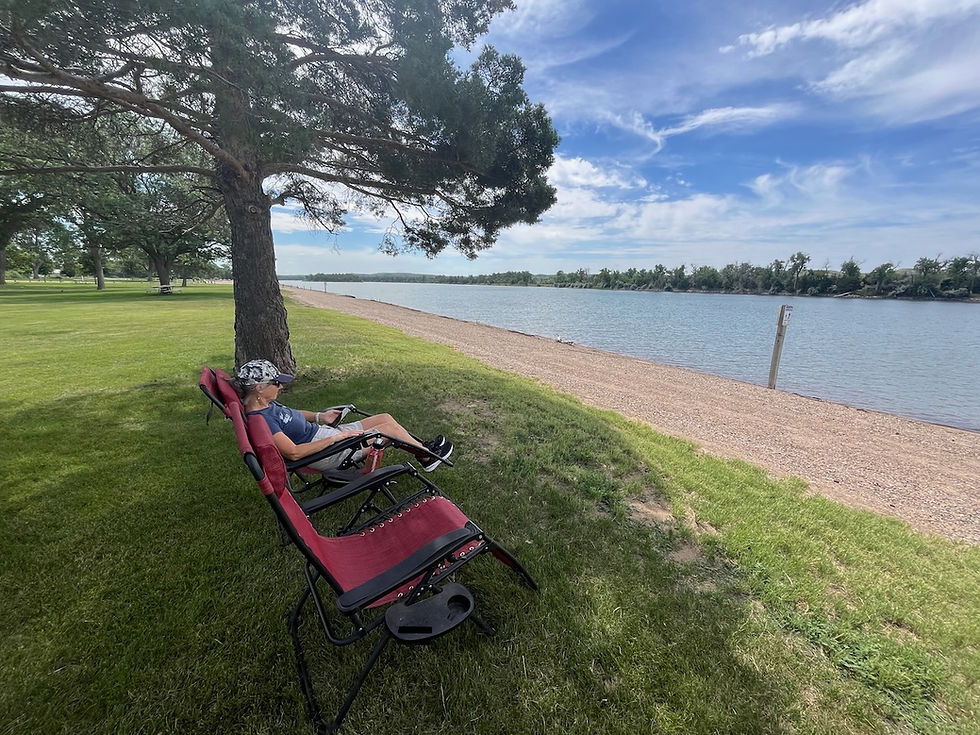
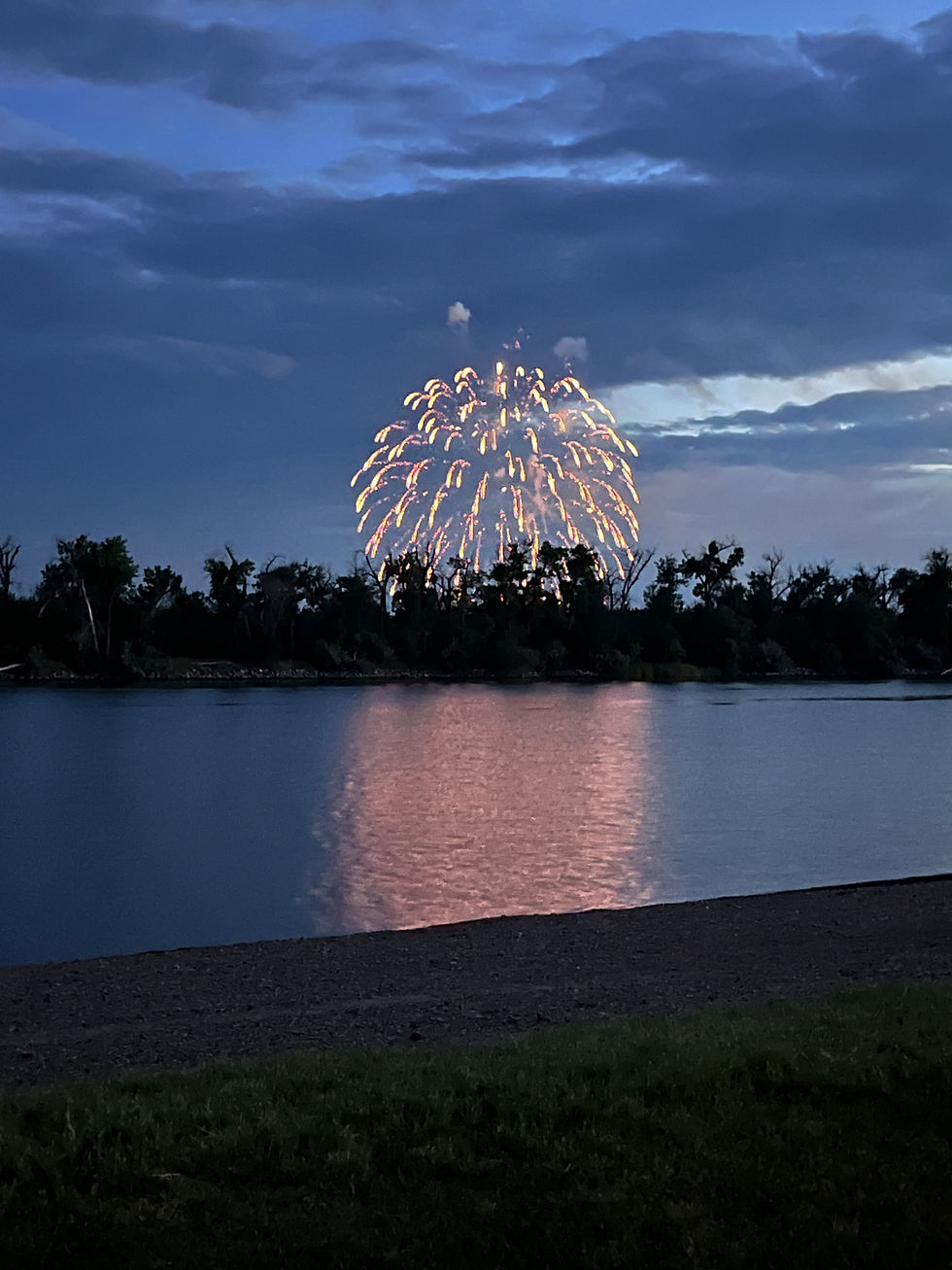
On the 4th of July we viewed the parade in Fort Pierre across the river and later Karen went to the evening rodeo with our RV neighbor Betty from Tennessee. That evening we enjoyed the fireworks from our campsite.


Comments