Encountered Marine Life in the Maldives
Dilemma | dəˈlemə, dīˈlemə |noun: a situation in which a difficult choice has to be made between two or more alternatives.
Before entering the water on every dive I find it challenging on what will get my attention. There is so much to see and experience. Hence, over five hundred images are on my computer from the 12 days we spent in the Maldives. Each dive presents multiple opportunities to find something new and unusual. Because of the limitations of field of view due to your mask or even a few feet of distance between you and the other divers in your group, they may see something that you'll miss entirely. The challenge for me is to find the balance between not wanting to miss anything and reconciling the fact that I will..
The Maldives, as a marine environment, are in good shape. Current reef health by region is mixed. The Northern Atolls (Baa & Lhaviyani) show the strongest health, with 30% to 50% coral cover with active UNESCO protection in areas like Hanifaru Bay. Central Atolls (North and South Malé) display variable and patchy recovery ranging from 15% to 40% cover due to heavy tourism and repeated thermal stress.


The region is known for the Whale Shark and Reef Manta Ray activity, but the variety of marine life was extremely diverse. The waters of the Maldives host over 2,000 species of fish, creating one of the richest marine ecosystems on Earth. It is easy to get distracted by all the large pelagic creatures in the blue. So many impressive large fish will visit us while on the reef, but some of the most unique creatures are almost invisible.

Hiden in these beautiful reef structures are some of the smallest creatures imaginable and you really need to look carefully or they get missed. Included in this group are Nudibranch. A nudibranch is a soft-bodied marine mollusk that sheds its shell after the larval stage, commonly known as a sea slug. The name comes from Latin and Greek words meaning "naked gills," referring to the exposed breathing structures on their backs. They are famous for bright, striking colors and diverse shapes.


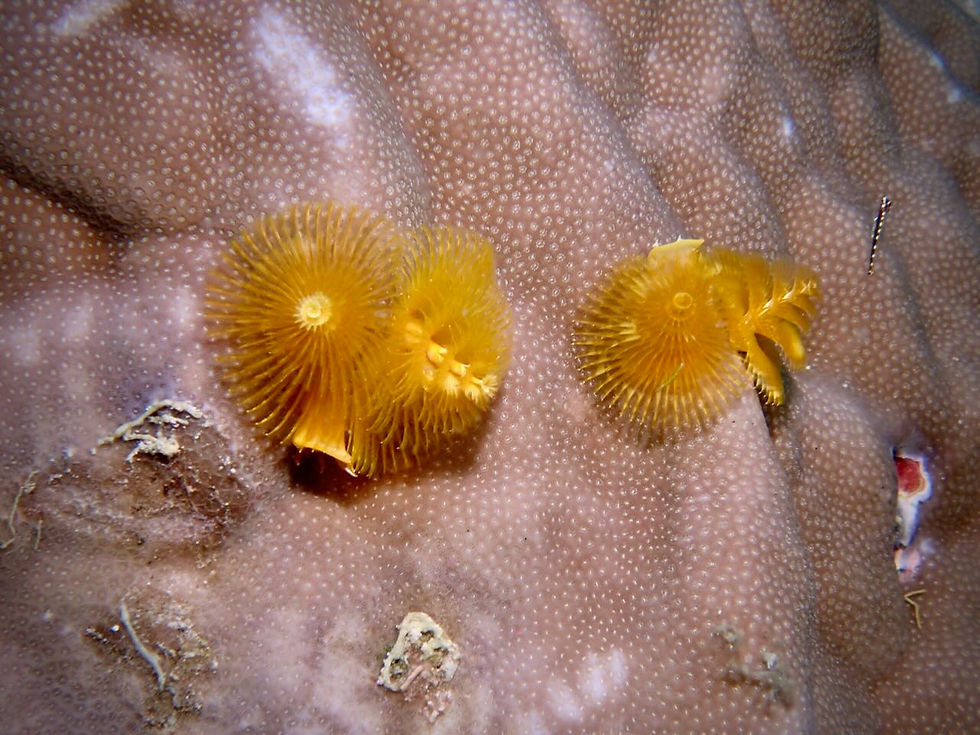
Another unique creature of the reef is the Christmas tree worm (Spirobranchus giganteus), a colorful, tube-building marine worm commonly found thriving in the coral reefs of the Maldives. The bright, spiral "trees" you see are actually twin crowns of tentacles called radioles, used for breathing and catching drifting plankton.
How about the The banded coral shrimp (Stenopus hispidus)? It is a striking, shrimp-like decapod crustacean recognized by its vibrant red-and-white bands and large, boxer-like front claws. They feature bright red and white stripes across their body and claws, spiny outer shells, stalked eyes, and very long white antennae. Adults usually grow between 2 to 3 inches.


Okay enough about the tiny stuff. Let move on to the larger inhabitants of the reef. Here are some creatures that use various means to disguise themselves from possible predators or use their camouflage as a means to a passive hunting approach. One of these marine species I got good at spotting is the Bearded Scorpion Fish. It acts as a stationary ambush predator, waiting motionless for small fish and crustaceans to pass before using fast suction to snap them up.


Other members of the reef hide and spend daytime hours tucked safely inside coral crevices, overhangs, and wreckage. like the Moray eels. The Maldives is home to around 40 species of moray eels, which thrive in its healthy coral reefs, thilas (submerged reefs), and channel entrances.

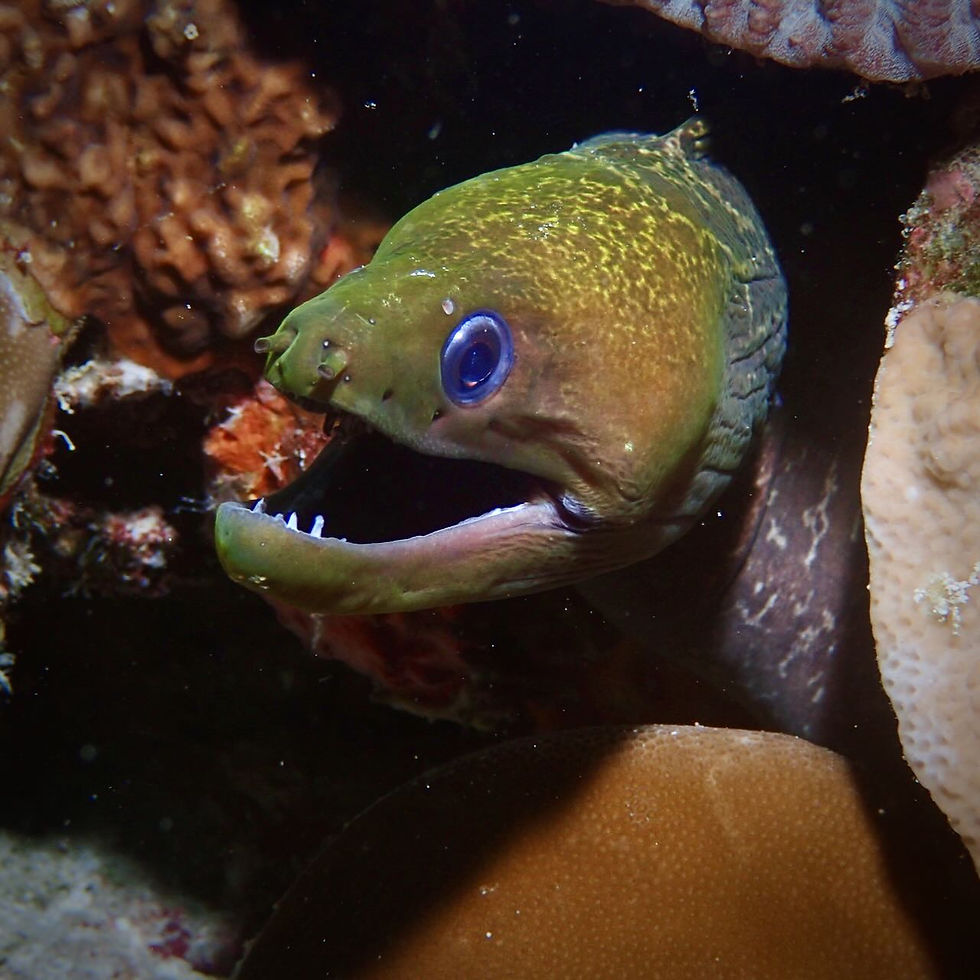
The Yellowmargin Moray is one of the largest moray eels found on coral reefs across the Indo-Pacific, including the Andaman Islands. Recognizable by its dark body covered in golden-yellow speckles, this nocturnal predator spends its days hidden within reef crevices and emerges at night to hunt fish, crustaceans, and cephalopods.

On many of the dives we encountered Green sea turtles either sleeping or eating on the reef.. Green sea turtles (Chelonia mydas) are among the most frequently spotted marine species in the Maldives, Adults are strictly herbivorous, using their strong jaws to graze on seagrass meadows, which helps keep the underwater ecosystem healthy.


A typical dive profile usually involved exploring the walls and overhangs of a reef or pinnacle feature. This is the transition area between the deep blue where the "big stuff" lives and the smaller reef life. As I swam a wall I would periodically gaze out into the open ocean for Mantas rays or sharks quietly passing by. Turning to the wall and reef I would often look for mollusk species. Five common examples of mollusks are snails, clams, octopuses, squids, and oysters.


How about Octopus? Well they're there but rather reclusive by nature during the daytime. However, we did see some and invfact Mathias won the titile of "Octopus Whisperer". He looked for them on every dive and often found multiple creatures on multiple dives.


Like corals, the giant clam lives in partnership with tiny plant-like algae (called zooxanthellae) that reside inside the clams’ tissues. And as with corals, the arrangement helps both creatures. The algae gain protection from grazing animals; the clam grows large with the benefit of food produced by the algae.

After 28 dives over 12 days it is easy to see much of the variety of life in and around the reef. With each dive I often reflect on the fact that this is one of the Creator's "Magical Kingdoms". Under the sea, in a world most people never see or experience, I have the pleasure and privilege to get up close and personal with its inhabitants. It's a place of serenity and joy with only the sound of bubbles.




I am so thankful that I was priviledged to shadow you and Karen on your exciting dive ventures, ogling familiar as well surprisingly new sea creatures. Blessings to you from all us land lubbers❣️👏🙏