Mesa Verde National Park

Our destination for Wednesday, September 10 was the Mesa Verde RV Resort in Manco, Colorado. This would be our home for the next three days. It is located between Cortez, Colorado and Durango, Colorado. After settling in I called around hoping to locate a diesel mechanic in the area. I was able to get an appointment with Comisky Automotive Service and Repair in Cortez for Thursday, September 11. I told Tom, the owner, our story with the truck issues and he said he would take a look and see what he could do. I ended up spending the entire day in the waiting room watching the news after the tragic killing of Charlie Kirk.
Tom and another mechanic spent the afternoon attempting to remove the EGR cooler assembly to look for a crack or leak but could not get the unit detached from the exhaust manifold due to some stripped bolts holding it in place. He made multiple attempts to do a "forced regen" with no real success. His final conclusion was to recommend we get to a RAM dealer for service. He stated that he suspected the EGR cooler was faulty but it would take over a week to get one and he didn't want to strand us here if we could get closer to home. He felt bad for us and only charged me a hour of labor after spending most of the afternoon trying to resolve the problem. Karen and I decided to drive on, hope for the best, keep adding coolant and pray the truck didn't breakdown in a remote part of our route on the way back to Texas.
We had hoped to see the Mesa Verde National Park and ride the Durango/Silverton Steam Railroad but the day spent in the shop forced us to decide between the two. The weather had been storming with occasional thunderstorms so we passed on the train for another time. Since we were close to the Mesa Verde site we opted for driving there. If we had any problems with the truck there would be US Park Rangers around to help.
For over 700 years, the Ancestral Pueblo people built thriving communities on the mesas and in the cliffs of Mesa Verde. Today, the park protects the rich cultural heritage of 27 Pueblo Tribes and offers visitors a spectacular window into the past.

The cliff dwellings of Mesa Verde are some of the most notable and best preserved in North America. Sometime during the late 1190s, after primarily living on the mesa tops for 600 years, many Ancestral Pueblo people began moving into pueblos they built into natural cliff alcoves. The structures ranged in size from one-room granaries to villages of more than 150 rooms. While still farming the mesa tops, they lived in cliff dwellings, repairing, remodeling, and constructing new rooms for nearly a century. In the mid-1200s, the population began migrating to the south, into present-day New Mexico and Arizona. By the end of the 1200s, most everyone had migrated away.
Our first stop was the Visitor's Center just up the road from our RV park. We gathered up a map and proceeded driving past the park ranger's kiosk up the plateau to the Chapin Mesa area about 20 miles away. We stopped at the first exhibit, a Pithouse site on the Square Tower House loop road.

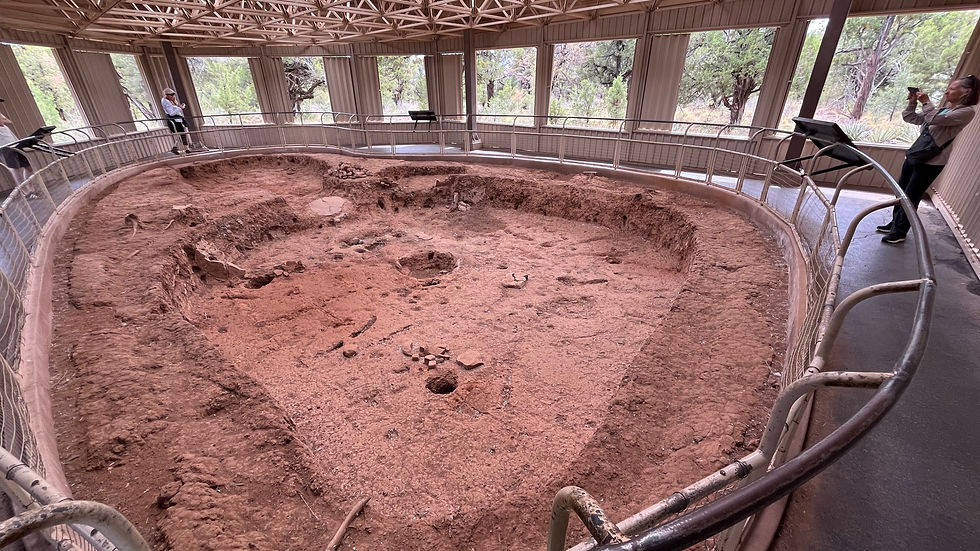
Here you see one of the oldest permanent structures built on the mesa, where early Ancestral Pueblo settlers enjoyed many of the same comforts we enjoy in our homes today.

Though nomadic people lived in the surrounding area for thousands of years, permanent farmsteads began to appear on the mesa around 550. Planting corn, beans, and squash, along with continuing to hunt and gather wild foods, gave them a more reliable and balanced food supply. The transition to farming allowed the Pueblo people to set down roots.
This new lifestyle spurred traditions and innovations that would last for centuries. Resourceful and attuned to their environment, the Ancestral Pueblo people took advantage of the earth’s natural insulation by building pithouses—semi-subterranean homes. The spear was replaced with a lighter and more accurate hunting tool: the bow and arrow. Light and portable basketry made way for durable pottery, better for storing and cooking food.
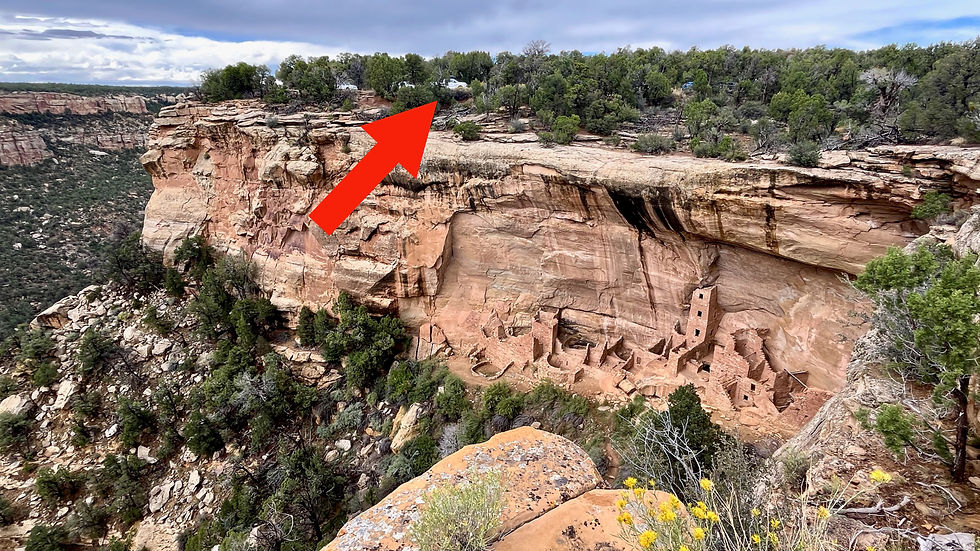

This cliff dwelling includes the tallest standing architecture in Mesa Verde, a four-story, 27-foot (8 m) tall structure that was part of an even larger building complex. Although the site has been stabilized by archeologists, 90% is original. Painted murals and rock art are found throughout Square Tower House. From the overlook, we looked for original roof beams and intact plastered walls.
Continuing around the loop we came to the Mesa Top Sites. Looking closely at this site and you see three villages built one on top of another. The people of the first village constructed their homes of mud or clay with a thatched roof. Later occupants built a second village on the same site with single-stone-wide sandstone masonry.
A third village, built around 1075, represents a major innovation with its use of double-stone, rubble-core masonry—two outer walls with soil and rock fill between them. This sturdy construction allowed for the building of large multi-story room blocks and towers. This village features three circular towers, which may have been used as signaling stations, astronomical observatories, watchtowers, or ceremonial structures. The kiva (a ceremonial room built wholly or partly underground) was a vital part of all three villages, gradually evolving into what archeologists refer to as the Mesa Verde style kiva.


Our loop continued to the Sun View Point where we got our first look at the iconic Cliff Palace across the valley. The Cliff Palace is the largest known cliff dwelling in North America. With over 150 rooms and 23 ceremonial kivas, it showcases the scale and sophistication of Ancestral Puebloan architecture. To get a closer look at the Cliff Palace we drove over to the other mesa loop on the opposite side of the valley.

Cliff Palace was constructed primarily out of sandstone, mortar and wooden beams. The sandstone was shaped using harder stones, and a mortar of soil, water and ash was used to hold everything together. "Chinking" stones were placed within the mortar to fill gaps and provide stability. Many of the walls were decorated with colored earthen plasters, which were the first to erode over time. Many visitors wonder about the relatively small size of the doorways at Cliff Palace; the explanation being that at the time the average man was under 5 feet 6 inches while the average woman was closer to 5 feet. Cliff Palace contains 23 kivas (round sunken rooms of ceremonial importance) and 150 rooms and had a population of approximately 100 people. One kiva, in the center of the ruin, is at a point where the entire structure is partitioned by a series of walls with no doorways or other access portals. The walls of this kiva were plastered with one color on one side and a different color on the opposing side. "It is thought that Cliff Palace was a social, administrative site with high ceremonial usage." Archaeologists believe that Cliff Palace contained more clans than the surrounding Mesa Verde communities. This belief stems from Mesa Verde's higher ratio of rooms to kivas. Cliff Palace has a room-to-kiva ratio of 9 to 1. The average room-to-kiva ratio for a Mesa Verde community is 12 to 1. This ratio of kivas to rooms may suggest that Cliff Palace might have been the center of a large polity (organized society) that included surrounding small communities.

Many of the sites are available to visit by taking a ranger led tour. Do the the rain and thunderstorms in the forecast all the tours for our day were cancelled. The last stop on the second loop was the Balcony House which you cannot even see from the parking lot and is only viewable on a tour taking the Soda Mountain trail about 1.2 miles. Because of the sketchy weather conditions we opted not to take the trail on this trip.
I would definitely recommend visiting the Mesa Verde National Park if you're in the area. The cliff dwellings are amazing to see up close. We want to come back and take the Durango/Silverton Train ride so I imagine we will get a second visit to this park in the future and we will definitely book the ranger tours next time.



Comments